Ships
Block-built spacecraft with sealed, walkable interiors: block icons, stats and costs generated from game data.
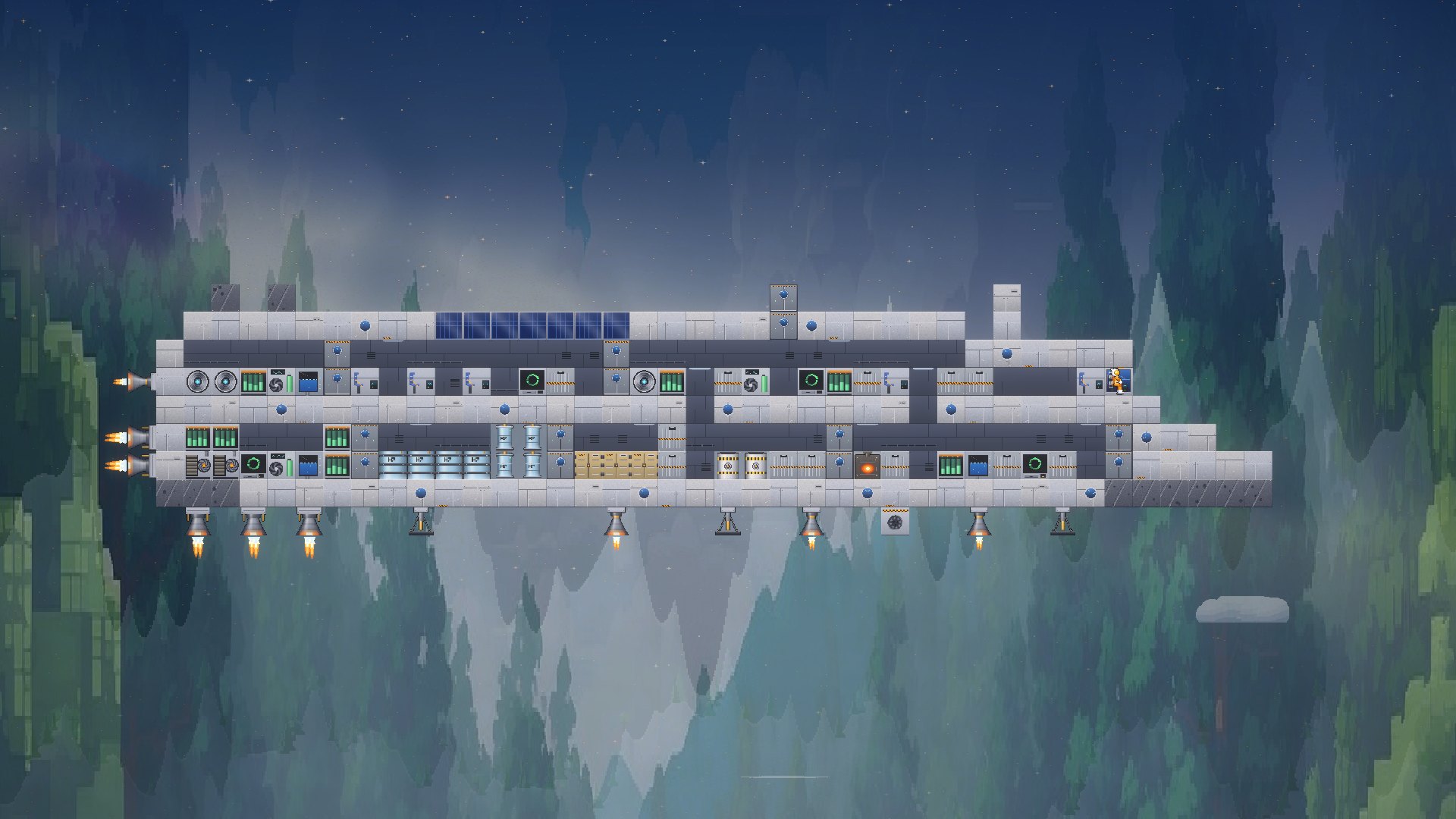
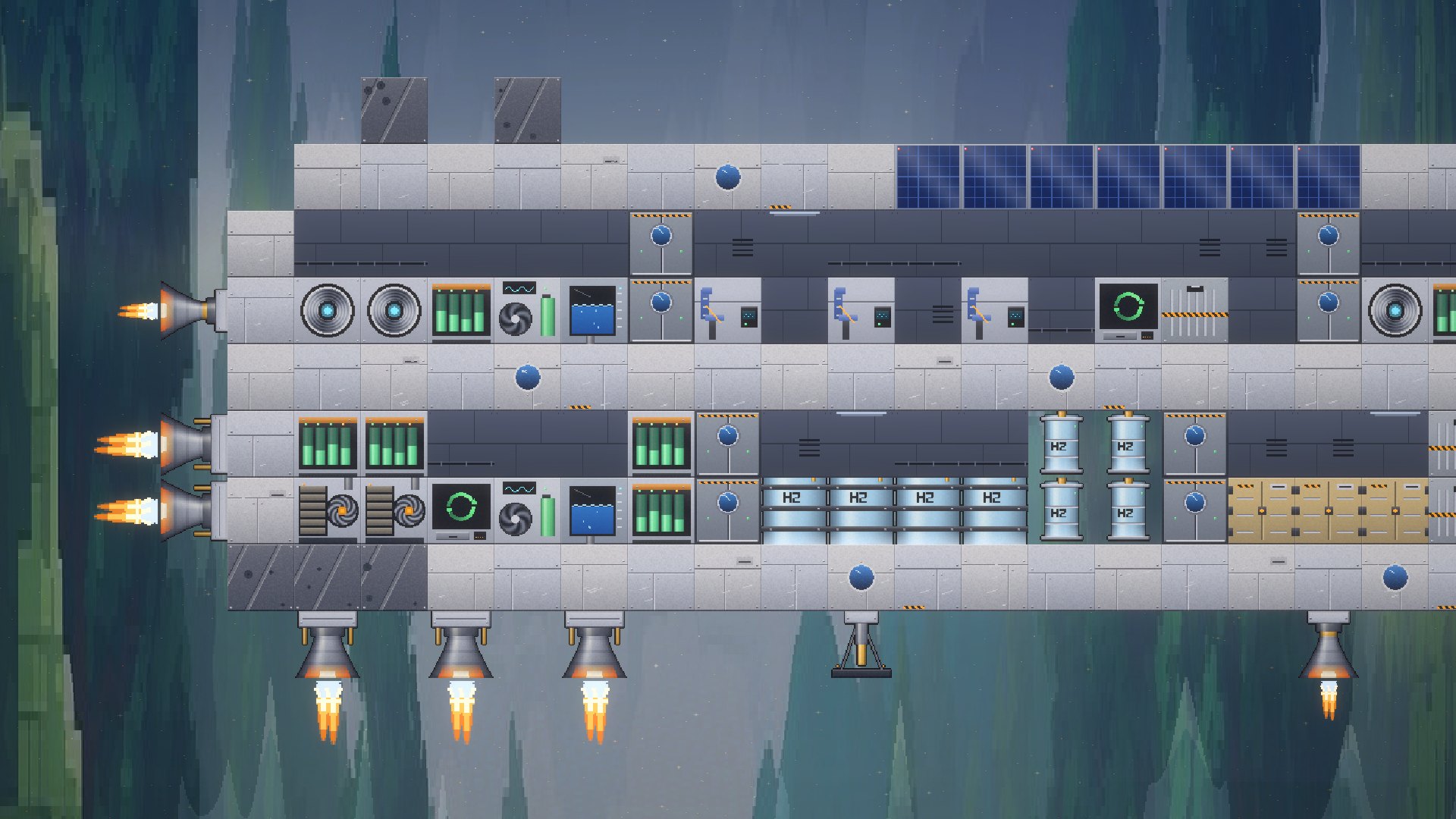
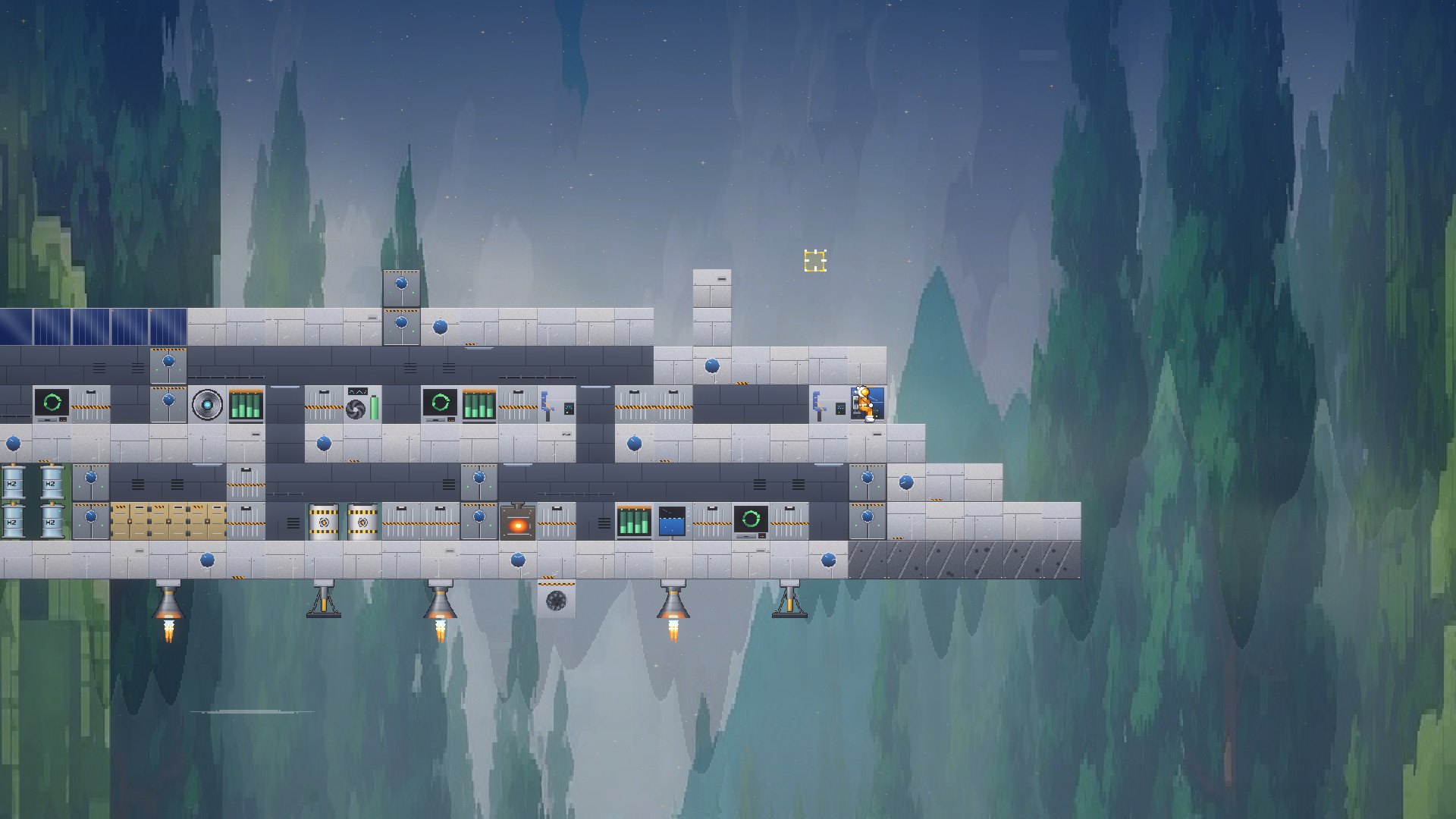
How to build a ship, step by step
- Unlock Ships in the research tree, then press
K(or Inventory → „Block ship") to open the ship builder. - Start with the Cockpit: it is the core of the ship (one per ship). Every other block must touch an existing block.
- Lay the keel and hull.
LMBplaces the selected block,RMBremoves one (refunds 50 % of materials). Blocks cost materials from your backpack. - Mount Thrusters under the hull (nozzle down = main lift).
Rrotates the nozzle while placing: side nozzles give lateral thrust, up gives retro. Every thruster needs a straight exhaust path. - Add H₂ tanks, a Gyroscope (rotation), Landing gear (soft touchdown) and a Battery + Solar panel for onboard power.
- Seal the interior: full shell of hull blocks + a Door (airlock). The game detects the hermetic interior automatically: install a Life support module with power and water and the inside fills with breathable air.
- Fuel up: place a Refuelling coupling touching the hull; park the ship so the coupling touches a pipe, tank or electrolyzer with hydrogen: it pumps 0.5 kg/s into your tanks.
- Board with
Eat the cockpit: the pilot sits down visibly at the console. Passengers board passenger seats the same way (co-op).
Flight controls
| Key | Action |
|---|---|
W / Space | main thrust (all down-facing nozzles) |
A / D | lateral thrust (side nozzles), wheels drive on the ground |
S | retro thrust (up-facing nozzles) |
Q / E | rotate the ship (needs a gyroscope and battery power) |
E | board / leave (short press at the cockpit or a seat) |
LMB | mining ship: run the drill (block „Mining drill", 1.5 kW) |
Climb above 240 m with positive vertical speed and you reach orbit: the system map opens and you can travel to other planets. Fuel is real: check the burn rate of your nozzles in the table below.
Land, sea and air vehicles
- Wheels drive on terrain using battery power: no fuel needed. More wheels = more force. Rovers and mining crawlers are ships too.
- Atmospheric rotors fly on electricity; thrust depends on air density: cheap planetary flight, useless in vacuum.
- Wooden hull + floats make boats: floats triple buoyancy; a paddle wheel or rotor propels them.
The interior is real simulation space: temperature, air and pressure are tracked. A closed hull with life support protects you from vacuum, toxic atmospheres and solar storms: your ship is a flying base with an onboard furnace, cargo holds and a water recycler.
All 27 ship blocks
| Block | Mass | Stats | Cost | What it does |
|---|---|---|---|---|
 Hull | 120 kg |  Steel plate 3 kg | Structural plate: connects blocks, provides collision, floats on water (buoyancy of 16×16 cells). 120 kg. | |
 Cockpit | 200 kg | 200 Wh | Steel plate 4 kg Integrated circuit 1 kg  Glass 2 kg | The ship's core: one per ship, start here. Seat, controls, camera. 200 kg. |
 Thruster | 150 kg | thrust 9 kN | Steel plate 3 kg Electric motor 1 kg | Hydrogen rocket engine: 9 kN of thrust, 30 g H₂/s. Nozzle down = thrust up (W); sideways = manoeuvre (A/D); up = retro (S). [R] rotates while placing. 150 kg. |
 H₂ tank | 90 kg | 40 kg H₂ | Steel plate 3 kg Steel 2 kg | 40 kg of hydrogen per block. 90 kg empty. |
 Gyroscope | 130 kg | Steel plate 2 kgElectric motor 1 kgIntegrated circuit 1 kg | Reaction wheels: let you rotate the ship (Q/E) and stabilise flight. More gyros = faster rotation. 130 kg. | |
 Landing leg | 80 kg | Steel plate 2 kg Steel rod 2 kg | Damped landing leg: soft touchdown, stable parking, slow self-levelling. 80 kg. | |
 Cargo hold | 110 kg | cargo 1500 kg | Steel plate 4 kg Structural frame 1 kg | 1500 kg of storage per block: [E] next to the ship opens the transfer panel. 110 kg empty. |
 Refuelling coupling | 90 kg | Steel plate 2 kgSteel 1 kg Copper 1 kg | Fuel port: when the ship is parked and a pipe, tank or electrolyser with hydrogen sits below/next to the coupling, H₂ flows into the ship's tanks (0.5 kg/s). This is how you refuel from your own production. | |
 Battery | 180 kg | 5000 Wh | Steel plate 2 kgCopper 3 kgIntegrated circuit 1 kg | 5 kWh of energy for gyros and the drill. Charged from solar panels. The cockpit has its own 200 Wh. |
 Solar panel | 60 kg | 600 W solar | Glass 3 kgIntegrated circuit 1 kgCopper 1 kg | 600 W in full sunlight (less at night/underground). Charges the ship's batteries. |
 Large thruster | 400 kg | thrust 27 kN | Steel plate 8 kgElectric motor 3 kgSteel 4 kg | Large hydrogen engine: 27 kN of thrust, 90 g H₂/s. Heavy (400 kg), for big ships. [R] rotates the nozzle. |
 Mining drill | 220 kg | Steel 4 kgElectric motor 2 kgSteel plate 2 kg | Mining ship: in flight LMB drills a 1.6×1.6 m area in front of the bit ([R] rotates it), the yield goes into the hold. Draws 1.5 kW from the battery. | |
 Passenger seat | 60 kg | Steel plate 1 kgSteel rod 1 kg | A place for a crew member (co-op: the second player boards with E at the seat and rides along). A crewed ship = seats + life-support module. | |
 Life-support module | 160 kg | Steel plate 3 kgIntegrated circuit 2 kgSteel 2 kg | O₂ generator + CO₂ scrubber: the inside of a sealed hull (enclosed by blocks, doors shut) holds breathable air. Draws 300 W and 1 g of water/s from the hold. | |
 Airlock (door) | 50 kg | Steel plate 2 kgElectric motor 1 kg | Hull door: E next to it opens/closes. Shut = a wall (airtight), open = the interior loses its air. | |
 Heavy armour | 320 kg | Steel 4 kgSteel plate 2 kg | A thick steel plate: survives hard landings and impacts (block damage, v2.1). 320 kg. | |
 Large hold | 300 kg | cargo 4500 kg | Steel plate 8 kgStructural frame 3 kgSteel 2 kg | 4500 kg of storage per block: for freighters. Unloaded through a coupling next to a crate. |
 Large H₂ tank | 260 kg | 160 kg H₂ | Steel plate 6 kgSteel 6 kg | 160 kg of hydrogen: interplanetary range for large ships. |
 Onboard generator | 150 kg | 2000 W | Steel plate 2 kgElectric motor 1 kgCopper 2 kg | Burns hydrogen from the tanks (0.05 g/s) → 2 kW into the battery. Power at night / underground for the drill, gyros and life support. 150 kg. |
 Water tank | 120 kg | cargo 200 kg | Steel plate 3 kgSteel 2 kg | 200 kg of water for life support and crew (the coupling loads water from a tank/pipe next to the ship; panel: "Water into the suit"). Without it, life support draws from the hold (50 kg). |
 Water and CO₂ recycler | 160 kg | Steel plate 3 kgIntegrated circuit 2 kgCopper 2 kg | Recovers water vapour and CO₂ from the cabin: life support uses 10× less water (+150 W). Long flights and base-ships without refilling water. | |
 Fluid hold | 220 kg | cargo 500 kg | Steel plate 5 kgSteel 4 kg | 500 kg of liquid/gas (oil, water, oxygen, kerosene, acid…). Coupling next to a tank: LOAD mode takes from the tank, UNLOAD gives back (ship panel). Fluid transport between bases and planets. |
 Wooden hull | 45 kg |  Wood 6 kg | Planks on ribs: a light, cheap all-wood hull for boats and first vehicles. Floats better than steel (45 kg instead of 120 kg), but does NOT hold vacuum and burns in fire. | |
 Drive wheel | 70 kg | Steel plate 2 kgElectric motor 1 kgSteel rod 1 kg | WHEELED drive: drives over terrain on battery power (no rocket fuel). A/D to move, climbs slopes, brakes by itself. More wheels means more force, mining vehicles and rovers. On water it acts as a paddle wheel (slower). | |
 Atmospheric rotor | 120 kg | Steel plate 3 kgElectric motor 2 kgIntegrated circuit 1 kg | ATMOSPHERIC drive: an electric propeller whose thrust depends on air density, cheap flight around a planet WITHOUT burning hydrogen. Useless in vacuum (rocket engines needed there). W/S up-down, A/D sideways. | |
 Float (keel) | 60 kg | Wood 4 kgSteel plate 1 kg | Buoyancy chamber: 3× more lift than a normal block and less rolling in waves. A wooden hull plus floats makes a boat; drive it with a paddle wheel or a rotor. | |
 Ship furnace | 300 kg | Steel 4 kgSteel plate 4 kgIntegrated circuit 1 kg | The ship's electric furnace: smelts ores FROM THE CARGO HOLD (up to 1900 K, iron, copper, glass, silicon, steel); the product goes back to the hold. Ore reduction consumes coal/coke from the hold. 6 kW of ship power, 0.25 kg/s. The heart of a mobile base. |