Virtual cursor on the sticks, A or LB/RT clicks, edges scroll lists
Text fields
Open the Steam on-screen keyboard automatically (chat, join address, world name)
Getting Started
From crash landing to your first automated base.
The first day
Leave the pod. KORA walks you through the first objectives (top left). The pod recharges your suit tanks and revives you if you die.
Watch the bars: oxygen, water, food. Drink with G, eat with F. On breathable worlds the visor opens automatically and oxygen is free.
Dig and gather with the hand drill (LMB). Everything is real matter with real mass: your suit carries 600 kg. Drop excess with Shift+RMB on an inventory slot, or store it in a crate.
Build with B (machines) and the welder tool (blocks). Machines need their construction cost in your backpack.
Craft in the assembler menu C near the pod or a workshop: tools, medkits, components.
Heat, gas and fire are real
Every 10 cm cell has temperature, pressure and contents. Heat spreads, gases mix and rise, liquids flow and boil.
Burning and smelting produce CO₂. Outdoors it blows away; indoors it accumulates and will suffocate you. Ventilate (vents, air purifier) or capture exhaust with a gas pump next to the furnace chimney.
Wood self-ignites around 300 °C. Lava ignites everything. Fire spreads with wind.
Research
Build a Science Lab and feed it materials to produce sample kits (higher tiers need plates, wire, pyrite, heavy ice, helium-3 regolith). Spend samples in the research panel to unlock machines and upgrades: see Research tree.
Automation basics
Conveyors move solids; inserters (feeder arms) load and unload machines with filters.
Pipes move fluids and gases; pumps push them; tanks store them.
Cables carry power from solar panels, generators and turbines; batteries buffer it.
Signals (levers, sensors, gates, timers) switch machines on and off automatically.
Refine metals, unlock Ships, build a block ship with a cockpit, tank hydrogen from your electrolyzers, reach orbit and travel the system. Wrecks of the ISV Kassandra hide the story: find the logs.
Machines
Every buildable machine (72), its icon, size, cost and capacity. Generated from game data.
Steel 16 kg, Brick 12 kg, Copper 8 kg, Integrated circuit 3 kg, Electric motor 1 kg
solid 120 kg
Coke oven
2.4×2 m
Brick 16 kg, Steel 6 kg, Copper 2 kg
solid 120 kg
Induction furnace
2.2×1.8 m
Steel 12 kg, Copper 10 kg, Integrated circuit 2 kg, Electric motor 1 kg
solid 100 kg
Blast furnace
3.2×3.4 m
Brick 40 kg, Steel 20 kg, Electric motor 2 kg, Steel plate 8 kg
solid 500 kg
Inserter (arm)
0.4×0.4 m
Steel 2 kg, Electric motor 1 kg, Integrated circuit 1 kg
Vertical lift
0.4×1.2 m
Iron 3 kg, Electric motor 1 kg, Copper 0.5 kg
Silo
1.4×2.2 m
Steel 10 kg, Steel plate 6 kg
solid 12000 kg
Steel converter
2×2.2 m
Steel 14 kg, Brick 20 kg, Electric motor 1 kg
fluid 50 kg, solid 200 kg
Rolling mill
2×1.2 m
Steel 12 kg, Electric motor 2 kg, Gear 4 kg
solid 120 kg
Lathe
1.4×1.2 m
Steel 8 kg, Electric motor 2 kg, Integrated circuit 1 kg
solid 80 kg
Laboratory
1.2×1.2 m
Steel 6 kg, Glass 4 kg, Integrated circuit 2 kg
Chemical plant
1.8×1.6 m
Steel 14 kg, Integrated circuit 3 kg, Electric motor 2 kg, Glass 4 kg
fluid 100 kg, solid 100 kg
Gas generator
1.6×1.2 m
Steel 8 kg, Electric motor 1 kg, Copper 3 kg
fluid 30 kg
Belt sorter
0.4×0.4 m
Steel 2 kg, Integrated circuit 1 kg, Electric motor 1 kg
Belt splitter
0.4×0.4 m
Steel 2 kg, Electric motor 1 kg
Liquefier
1.2×1.2 m
Steel 8 kg, Copper 4 kg, Integrated circuit 2 kg, Electric motor 1 kg
fluid 60 kg
Crossover (bridge)
0.4×0.4 m
Steel 1 kg, Steel plate 0.5 kg
Screen
1.4×1.2 m
Iron 6 kg, Electric motor 1 kg, Steel plate 2 kg
solid 200 kg
Oxygen generator
1.2×1.2 m
Steel 6 kg, Integrated circuit 1 kg, Copper 2 kg
fluid 40 kg, solid 150 kg
Desalinator
1.2×1.2 m
Steel 4 kg, Copper 2 kg, Glass 2 kg
fluid 100 kg, solid 60 kg
Oil refinery
2×1.6 m
Steel 12 kg, Steel plate 4 kg, Integrated circuit 2 kg, Electric motor 1 kg
fluid 100 kg, solid 100 kg
Large tank
1.6×2.6 m
Steel 18 kg, Steel plate 8 kg
fluid 5000 kg
Underground pipe
0.4×0.4 m
Iron 1.5 kg
fluid 10 kg
Gas pump
1×1 m
Steel 5 kg, Copper 1 kg, Electric motor 1 kg
fluid 10 kg
Water purifier
1.2×1.2 m
Steel 5 kg, Copper 2 kg, Glass 2 kg
fluid 100 kg, solid 60 kg
Leaching plant
1.2×1.2 m
Steel 8 kg, Glass 4 kg, Integrated circuit 1 kg
solid 200 kg
Inclined belt
0.4×0.8 m
Iron 0.8 kg, Copper 0.1 kg
Pod (core)
0.1×0.1 m
1000 Wh
Materials
All 141 materials of the simulation with their in-game icons. ☢ = radioactive. Generated from game data.
Material
Phase
Density
Transforms when hot
Aluminium
Solid
2700 kg/m³
660 °C → Molten aluminium
Ammonia (NH₃)
Gas
0.7 kg/m³
Argon (Ar)
Gas
1.8 kg/m³
Ash
Powder
700 kg/m³
1327 °C → Molten slag
Basalt
Solid
2900 kg/m³
1177 °C → Lava
Bauxite (aluminium ore)
Solid
2500 kg/m³
2027 °C → Molten slag
Bedrock
Solid
3000 kg/m³
Berries
Solid
700 kg/m³
Bitumen (asphalt)
Solid
1050 kg/m³
Brass
Solid
8500 kg/m³
930 °C → Molten copper
Brick
Solid
1900 kg/m³
1627 °C → Molten slag
Bronze
Solid
8800 kg/m³
950 °C → Molten copper
Bush
Solid
300 kg/m³
Cactus
Solid
400 kg/m³
Carbon dioxide (CO₂)
Gas
2 kg/m³
Carbon monoxide (CO)
Gas
1.3 kg/m³
Cassiterite (tin ore)
Solid
6900 kg/m³
1627 °C → Molten slag
Chemical filter (activated carbon)
Solid
500 kg/m³
427 °C → Ash
Chemical sample
Solid
1700 kg/m³
1127 °C → Slag
Chlorine (Cl₂)
Gas
3.2 kg/m³
Clay
Solid
1800 kg/m³
927 °C → Brick
Coal
Solid
1350 kg/m³
Coke
Solid
1100 kg/m³
Combustion engine
Solid
6500 kg/m³
1227 °C → Slag
Concrete
Solid
2400 kg/m³
1527 °C → Molten slag
Contaminated water ☢
Liquid
1010 kg/m³
100 °C → Steam
Copper
Solid
8960 kg/m³
1085 °C → Molten copper
Copper concentrate
Powder
3800 kg/m³
1227 °C → Molten slag
Copper ore (malachite)
Solid
3900 kg/m³
1227 °C → Molten slag
Copper wire
Solid
8960 kg/m³
1085 °C → Molten copper
Crude oil
Liquid
870 kg/m³
Crystal
Solid
2600 kg/m³
1627 °C → Molten glass
Depleted uranium ☢
Powder
19050 kg/m³
1132 °C → Molten uranium
Dirty water
Liquid
1030 kg/m³
100 °C → Steam
Dry ice
Ice
1560 kg/m³
-78 °C → Carbon dioxide (CO₂)
Electric motor
Solid
7000 kg/m³
1227 °C → Slag
Electronic sample
Solid
2000 kg/m³
1227 °C → Slag
Enriched uranium (UO₂) ☢
Powder
10970 kg/m³
2827 °C → Molten uranium
Fertiliser (ammonium sulphate)
Solid
1770 kg/m³
Flowers
Solid
200 kg/m³
Fuel rod ☢
Solid
9000 kg/m³
2827 °C → Molten uranium
Galena (lead ore)
Solid
7400 kg/m³
1117 °C → Molten slag
Gear
Solid
7850 kg/m³
1427 °C → Molten iron
Glass
Solid
2500 kg/m³
1427 °C → Molten glass
Gold
Solid
19300 kg/m³
1064 °C → Molten gold
Gold dust
Powder
15000 kg/m³
1064 °C → Molten gold
Gold-bearing gravel
Powder
1850 kg/m³
1227 °C → Lava
Granite
Solid
2700 kg/m³
1227 °C → Lava
Grass
Solid
200 kg/m³
Gravel
Powder
1800 kg/m³
1227 °C → Lava
Heavy ice (deuterium)
Ice
1105 kg/m³
4 °C → Water
Helium (He)
Gas
0.2 kg/m³
Helium-3 regolith
Powder
1600 kg/m³
1527 °C → Slag
Hide
Solid
900 kg/m³
Hull (titanium alloy)
Solid
4500 kg/m³
1668 °C → Molten slag
Hydrogen (H₂)
Gas
0.1 kg/m³
Ice
Ice
917 kg/m³
0 °C → Water
Ilmenite (titanium ore)
Solid
4700 kg/m³
1427 °C → Molten slag
Integrated circuit
Solid
2500 kg/m³
1227 °C → Slag
Iron
Solid
7874 kg/m³
1538 °C → Molten iron
Iron concentrate
Powder
4000 kg/m³
1565 °C → Molten slag
Iron ore (hematite)
Solid
4200 kg/m³
1565 °C → Molten slag
Kerosene
Liquid
800 kg/m³
Lava
Liquid
2800 kg/m³
Lead
Solid
11340 kg/m³
328 °C → Molten lead
Leaves
Solid
300 kg/m³
Liquid hydrogen
Liquid
71 kg/m³
-253 °C → Hydrogen (H₂)
Liquid methane
Liquid
422 kg/m³
-161 °C → Methane (CH₄)
Liquid nitrogen
Liquid
808 kg/m³
-196 °C → Nitrogen (N₂)
Liquid oxygen
Liquid
1141 kg/m³
-183 °C → Oxygen (O₂)
Lithium
Solid
534 kg/m³
181 °C → Molten slag
Meat
Solid
1050 kg/m³
127 °C → Ash
Mechanical sample
Solid
2200 kg/m³
1227 °C → Slag
Medkit
Solid
350 kg/m³
227 °C → Ash
Methane (CH₄)
Gas
0.7 kg/m³
Molten aluminium
Liquid
2375 kg/m³
Molten copper
Liquid
8000 kg/m³
Molten glass
Liquid
2400 kg/m³
Molten gold
Liquid
17300 kg/m³
Molten iron
Liquid
7000 kg/m³
Molten lead
Liquid
10660 kg/m³
Molten nickel
Liquid
7810 kg/m³
Molten silicon
Liquid
2570 kg/m³
Molten slag
Liquid
2600 kg/m³
Molten sulphur
Liquid
1800 kg/m³
445 °C → Sulphur dioxide (SO₂)
Molten tin
Liquid
6990 kg/m³
Molten titanium
Liquid
4110 kg/m³
Molten uranium ☢
Liquid
17300 kg/m³
Molten zinc
Liquid
6570 kg/m³
Monazite (thorium ore) ☢
Solid
5000 kg/m³
2027 °C → Molten slag
Moss
Solid
300 kg/m³
Mushrooms
Solid
300 kg/m³
Nickel
Solid
8908 kg/m³
1455 °C → Molten nickel
Nitrogen (N₂)
Gas
1.3 kg/m³
Nuclear sample
Solid
4200 kg/m³
1327 °C → Slag
Obsidian
Solid
2400 kg/m³
1027 °C → Lava
Oxygen (O₂)
Gas
1.4 kg/m³
Particulate filter (HEPA)
Solid
400 kg/m³
327 °C → Ash
Pentlandite (nickel ore)
Solid
4800 kg/m³
1127 °C → Molten slag
Plastic
Solid
950 kg/m³
Pod window
Solid
2500 kg/m³
1627 °C → Molten glass
Pyrite (sulphur ore)
Powder
5010 kg/m³
1177 °C → Molten slag
Quantum sample
Solid
3000 kg/m³
1327 °C → Slag
Quartz
Solid
2650 kg/m³
1710 °C → Molten glass
Radiological filter (lead + zeolite)
Solid
2600 kg/m³
627 °C → Slag
Radon (Rn) ☢
Gas
9.7 kg/m³
Rare earth metals
Powder
6500 kg/m³
1327 °C → Slag
Ration pack
Solid
600 kg/m³
Regolith
Powder
1500 kg/m³
1227 °C → Lava
Rock salt
Solid
2160 kg/m³
801 °C → Salt water
Salt water
Liquid
1025 kg/m³
102 °C → Steam
Sand
Powder
1600 kg/m³
1427 °C → Molten glass
Sandstone
Solid
2300 kg/m³
1427 °C → Molten glass
Silicon
Solid
2330 kg/m³
1414 °C → Molten silicon
Slag
Solid
2700 kg/m³
1177 °C → Molten slag
Snow
Powder
300 kg/m³
0 °C → Water
Soil
Solid
1500 kg/m³
1327 °C → Lava
Spent fuel ☢
Solid
9000 kg/m³
2827 °C → Molten uranium
Sphalerite (zinc ore)
Solid
4000 kg/m³
1127 °C → Molten slag
Spodumene (lithium ore)
Solid
3100 kg/m³
1427 °C → Molten slag
Steam
Gas
0.6 kg/m³
Steel
Solid
7850 kg/m³
1427 °C → Molten iron
Steel plate
Solid
7850 kg/m³
1427 °C → Molten iron
Steel rod
Solid
7850 kg/m³
1427 °C → Molten iron
Structural frame
Solid
7850 kg/m³
1427 °C → Molten iron
Sulphur
Solid
2070 kg/m³
115 °C → Molten sulphur
Sulphur dioxide (SO₂)
Gas
2.9 kg/m³
Sulphuric acid
Liquid
1840 kg/m³
337 °C → Sulphur dioxide (SO₂)
Thorium ☢
Solid
11700 kg/m³
1750 °C → Molten slag
Tin
Solid
7310 kg/m³
232 °C → Molten tin
Titanium
Solid
4506 kg/m³
1668 °C → Molten titanium
Turf
Solid
1400 kg/m³
1327 °C → Lava
Uraninite (uranium ore) ☢
Solid
6500 kg/m³
2827 °C → Molten slag
Uranium ☢
Solid
19050 kg/m³
1132 °C → Molten uranium
Uranium concentrate (yellowcake) ☢
Powder
4000 kg/m³
2827 °C → Molten slag
Vanadium
Solid
6110 kg/m³
1910 °C → Molten iron
Vanadium ore (V-magnetite)
Powder
4700 kg/m³
1827 °C → Slag
Vine
Solid
300 kg/m³
Water
Liquid
1000 kg/m³
100 °C → Steam
Wood
Solid
600 kg/m³
Zinc
Solid
7140 kg/m³
420 °C → Molten zinc
Furnaces & Smelting
What melts into what, at which temperature. Generated from game data.
Furnace types
Furnace
Heat source
Speed
Notes
Basic furnace
wood / coal
0.12 kg/s
your first smelter; wood burns cooler than coal
Furnace
coal / coke
0.25 kg/s
the workhorse; coke burns hotter and cleaner
Blast furnace
coke (0.06 kg/s) + power
1.0 kg/s
iron and copper only, needs electricity for the blast
Arc furnace
electricity only
0.5 kg/s
no exhaust; heats ~50 K/s; best late-game smelter
Fuel energy: wood 16 MJ/kg · coal 24 MJ/kg · coke 30 MJ/kg. Smelting consumes about 180 K of furnace heat per kg, so the furnace settles just under the recipe temperature and works continuously.
Coal furnaces exhale CO₂ (3.67 kg per kg of coal) through the chimney. Put a gas pump or tank next to the furnace to capture it, or keep smelting outdoors/ventilated.
Smelting recipes
Input
Output
Min temperature
Needs coal/coke as reductant
Yield
Clay
Brick
927 °C
no
100 %
Iron ore (hematite)
Iron
1227 °C
yes
70 %
Copper ore (malachite)
Copper
1127 °C
yes
60 %
Iron
Steel
1427 °C
yes
100 %
Sand
Glass
1427 °C
no
100 %
Iron concentrate
Iron
1227 °C
yes
70 %
Copper concentrate
Copper
1127 °C
yes
60 %
Gold dust
Gold
1067 °C
no
100 %
Galena (lead ore)
Lead
1027 °C
yes
80 %
Sphalerite (zinc ore)
Zinc
1027 °C
yes
60 %
Cassiterite (tin ore)
Tin
1027 °C
yes
70 %
Pentlandite (nickel ore)
Nickel
1477 °C
yes
50 %
Ilmenite (titanium ore)
Titanium
1827 °C
yes
50 %
Quartz
Silicon
1527 °C
yes
45 %
Vanadium ore (V-magnetite)
Vanadium
1910 °C
yes
45 %
Pyrite (sulphur ore)
Sulphur
827 °C
no
50 %
Ores can be crushed to concentrate first (see Processing): concentrate smelts with a better yield. The leaching plant is an alternative wet route with the best yields.
Processing Chains
Crusher, leaching plant, mills, lathe and assemblers. Generated from game data.
Crusher
Feed ore or rock with the welder (LMB) or an inserter. 0.5 kg/s with full power.
Input
Output
Byproduct
Granite
Gravel
Iron ore (hematite)
Iron concentrate
Copper ore (malachite)
Copper concentrate
Slag
Gravel
Hull (titanium alloy)
Steel
Sandstone
Gravel
Basalt
Gravel
Pod window
Glass
Gravel
Sand
Gold-bearing gravel
Sand
Gold dust (0.2 %)
Uraninite (uranium ore)
Uranium concentrate (yellowcake)
Quartz
Sand
Steel plate
Steel
Copper wire
Copper
Gear
Steel
Steel rod
Steel
Integrated circuit
Copper
Electric motor
Steel
Combustion engine
Steel
Structural frame
Steel
Leaching plant (wet route)
Needs sulfuric acid from an adjacent pipe/tank (0.05 kg/s): see Chemistry. Better yields than smelting:
Ore
Output
Yield
Copper ore
Copper
80 %
Zinc ore
Zinc
80 %
Lead ore
Lead
85 %
Nickel ore
Nickel
75 %
Uranium ore
Uranium concentrate
95 %
Gold-bearing gravel
Gold dust
0.6 %
Mills, lathe, converter, sifter
Set the machine mode with E. Steel comes from the converter (iron 95 %).
Machine
Mode
Input
Output
Yield
Rate
Konwertor
0
Iron
Steel
95 %
0.4 kg/s
Konwertor
1
Iron
Steel
95 %
0.4 kg/s
Konwertor
2
Iron
Steel
95 %
0.4 kg/s
Konwertor
3
Iron
Steel
95 %
0.4 kg/s
Screen
0
Gold-bearing gravel
Gold dust
0.3 %
1 kg/s
Screen
1
Regolith
Iron concentrate
12 %
0.8 kg/s
Screen
2
Sand
Quartz
35 %
0.6 kg/s
Screen
3
Gravel
Sand
80 %
0.8 kg/s
Rolling mill
0
Steel
Steel plate
100 %
0.3 kg/s
Rolling mill
1
Steel
Steel rod
100 %
0.3 kg/s
Rolling mill
2
Copper
Copper wire
100 %
0.3 kg/s
Lathe
0
Steel plate
Gear
50 %
0.2 kg/s
Lathe
1
Steel rod
Structural frame
25 %
0.2 kg/s
Assembler & Science Lab (input + additive)
These take a main input plus an additive in the fuel slot:
Chemical plant modes, exact ratios from the simulation.
Chemical plant: gas & liquid modes
Mode
Reaction
Inputs (adjacent pipe/tank)
Output
Ratio
0
Sabatier
CO₂ + hydrogen
methane (+ water spills out)
44 kg CO₂ + 8 kg H₂ → 16 kg CH₄ + 36 kg H₂O
1
Haber
nitrogen + hydrogen
ammonia
28 kg N₂ + 6 kg H₂ → 34 kg NH₃
2
Oil distillation
crude oil
methane + sulfur + slag
1 kg oil → 0.35 kg CH₄ + 0.05 kg S
Chemical plant: solid modes
Mode
Process
Inputs
Output
Yield
3
Sulfuric acid
sulfur (hopper) + water + oxygen (pipes)
sulfuric acid (fluid)
1 kg S + 0.56 kg H₂O + 1.5 kg O₂ → 3.06 kg acid
4
Alumina reduction
bauxite
aluminium
50 %
5
Kroll process
titanium ore + chlorine (0.5 kg/kg, from brine electrolysis)
titanium
55 %
6
Lithium extraction
lithium ore
lithium
30 %
7
Fertilizer
ammonia (0.35 kg) + sulfuric acid (1 kg)
fertilizer
1.35 kg per kg acid
8
Plastics
kerosene (refinery)
plastic
60 %
Water purifier
Pulls dirty or contaminated water from an adjacent pipe/tank, outputs clean water (95 %), 600 W. The waste (mud, or uranium dust from contaminated water) collects as a solid: collect with E.
Chemical plants pull fluids from ADJACENT tanks and pipes: put a tank with each reagent right next to the plant, and an empty pipe/tank on the output side.
Power & the Reactor
Cables, generation, storage, and the full uranium chain.
The grid
Cables connect machines to sources: they run in their own layer, so they can share cells with terrain.
When demand exceeds supply, machines slow down proportionally (their status shows the power ratio).
Batteries store 5 kWh each and smooth day/night cycles; research Superconductors to boost them.
Generation
Source
Power
Fuel
Notes
Solar panel
daylight-dependent
sunlight
free, but night and storms cut it
Generator
small
coal/wood
early game stopgap, makes CO₂
Gas generator
5 kW
methane / hydrogen / kerosene
pipe the fuel in; CH₄ and kerosene exhaust CO₂
Steam turbine
large
steam
pair with the reactor or any boiler
The uranium chain, end to end
Uranium ore: mine it (watch the ☢ dose) or purify contaminated water.
Centrifuge (4 kW): each pass turns 5 % of the feed into enriched uranium, the rest exits as depleted uranium. Chain several centrifuges in a cascade: belt the enriched output of one into the next.
Fuel rod: craft in the assembler menu: 4 kg enriched uranium + 1 kg steel → 4 kg fuel cassette.
Reactor (2.8×2.8 m): load fuel rods. Produces ~2.4 MW of HEAT directly into its concrete core.
Cooling: run water pipes/tanks TOUCHING the reactor: they draw heat (3 kW per kelvin per neighbour), water boils to steam.
Steam → turbines → power. Condense or vent the exhaust.
Meltdown is real. The core has positive feedback: above ~1130 °C it produces MORE heat. Without cooling, an ignited core melts through the floor in about 10 minutes. Research SCRAM: it auto-shuts the reactor at 1727 °C. Keep radiation shielding (lead) between the reactor and your crew.
Pipes, Fluids & Ventilation
Moving liquids and gases without flooding your base.
PipeInsulated pipePumpGas pumpTankValve
Pipes and pumps
Pipes carry liquids and gases between machines; the material you build them from sets their temperature tolerance (copper/iron/steel/aluminium/glass/brick/concrete).
Insulated pipes keep hot fluids hot (steam!); radiant pipes deliberately shed heat: use them as radiators.
Pumps push fluids from the world into pipes (place in liquid, LMB); gas pumps take from the top: park one next to a furnace chimney to capture CO₂.
Tanks buffer fluids; valves gate flow and can be signal-controlled.
Ventilation
Vents exchange air between inside and outside; the air purifier filters CO₂, toxins and radioactive dust with the right filter installed (HEPA / charcoal / lead-zeolite).
Hot gases rise. Chimneys above furnaces + a capture pump beat scrubbing later.
Watch the top-right air panel: pressure, O₂ share, temperature, toxins, dose. BREATHABLE means the helmet can open.
Boiling, freezing, phase changes
Every fluid has real transition points (see Materials): water boils to steam at 100 °C, freezes at -1 °C; steam condenses back; methane condenses at cryogenic temperatures. Machines and the world both respect these: your cooling loop can literally freeze solid on an ice world.
Research Tree
All technologies, their costs and unlocks. Generated from game data.
Technology
Effect
Cost (samples)
Requires
Unlocks machines
Precision metallurgy I
Better furnace lining and atmosphere control: +15 % yield on every smelt.
Mechanical sample 30
hutnictwo2
Precision metallurgy II
Oxygen blowers and pre-heated charge: +35 % smelting yield in total.
Electronic sample 40, Chemical sample 25
wytop1
Energy efficiency I
Inverters and better windings: every machine draws 12 % less power.
Electronic sample 25
logika
Energy efficiency II
Heat recovery and load control: −25 % power draw in total.
Electronic sample 45, Chemical sample 30
energia1
Mining tools I
Sintered carbide tips: the drill, hammer and welder work 25 % faster.
Mechanical sample 20
Mining tools II
Pulse drive and cooling: tools 60 % faster in total.
Electronic sample 40, Nuclear sample 10
narzedzia1
Research methodology I
Repeatable procedures: every further research costs 15 % fewer samples.
Mechanical sample 35
Research methodology II
Automated data analysis: −30 % research cost in total.
Electronic sample 50, Chemical sample 35
nauka1
Reactor safeguards (SCRAM)
Safety rods and emergency automation: at 1727 °C the reactor shuts itself down instead of melting. Without this technology an overheated core melts and burns through the floor.
Nuclear sample 15, Electronic sample 20
atom
Reactors II
Deep burnup and better moderators: the reactor and turbine deliver 40 % more power.
Nuclear sample 30, Chemical sample 25
atom
Chemistry II
Catalysts: the chemical plant, refinery and liquefier run 50 % faster.
Vanadium from volcanic and metallic worlds in your engine steel: ALL ship thrusters give +25 % thrust. Your old ship still flies, the new one is simply better.
Vanadium 20, Mechanical sample 40
hutnictwo2
Superconductors (rare earths)
Rare earth metals from metallic and radioactive worlds: batteries hold +60 % energy and the grid stops sagging under load.
Rare earth metals 25, Electronic sample 40
energia1
Quantum physics (Helix core)
Understand what killed the Kassandra: the requirement for ending A (rebuilding the Helix drive) and the top of the tech tree.
Quantum sample 60, Nuclear sample 40, Chemical sample 40
Gas centrifuge, nuclear reactor, steam turbine (lead shielding!).
Mechanical sample 40, Electronic sample 30
hutnictwo2
Centrifuge, Reactor, Turbine
Industrial chemistry
Chemical plant (Sabatier CO₂+H₂→CH₄, Haber N₂+H₂→NH₃, oil distillation → CH₄+S), gas generator (5 kW from CH₄/H₂), liquefier (LOX/LH₂/LCH₄/LN₂) and oil refinery (kerosene, bitumen).
Bronze plain bearings: two motors from a single frame.
Integrated circuit (brass contacts) ×2
Silicon 1 kg, Brass 1 kg
Integrated circuit 2 kg
Brass instead of copper wire: 2 circuits from 1 kg of silicon.
Integrated circuit (plastic casing) ×3
Silicon 1 kg, Plastic 1 kg, Copper wire 1 kg
Integrated circuit 3 kg
Plastic from the chemical plant (kerosene → plastic): 3 circuits from 1 kg of silicon.
Medkit ×2
Plastic 1 kg, Steel plate 1 kg, Berries 1 kg
Medkit 2 kg
Dressings, a plant extract and a sterile case. [V] instantly restores 55 HP. Carry as many as you like: they count towards your carry weight.
Particulate filter (HEPA)
Plastic 1 kg, Steel plate 1 kg
Particulate filter (HEPA) 2 kg
For the air scrubber: captures CO2, steam and dust. The basic filter to use around furnaces.
Chemical filter (activated carbon)
Coal 2 kg, Steel plate 1 kg
Chemical filter (activated carbon) 2 kg
For the air scrubber: absorbs toxic gases (SO2, Cl2, NH3, CO).
Radiological filter
Lead 2 kg, Quartz 1 kg, Steel plate 1 kg
Radiological filter (lead + zeolite) 2 kg
For the air scrubber: captures radon. Essential on radioactive planets.
Fuel rod (reactor)
Enriched uranium (UO₂) 4 kg, Steel 1 kg
Fuel rod 4 kg
UO₂ pellets in steel cladding: fuel for the reactor.
★ COMBUSTION ENGINE
Steel plate 4 kg, Gear 4 kg, Steel rod 2 kg, Structural frame 1 kg
Combustion engine 1 kg
MILESTONE: from ore to engine. Drives vehicles and generators.
Unlock: Jackhammer
Steel plate 4 kg, Gear 2 kg, Electric motor 1 kg
Unlock: Jackhammer
A 21×21 tool (hammer), very fast rock breaking.
Upgrade the drill
Steel plate 2 kg, Gear 1 kg
Upgrade the drill
Drill: +50% speed and range.
Upgrade the pump
Steel plate 2 kg, Copper wire 2 kg
Upgrade the pump
Pump: +50% throughput.
Upgrade the welder
Steel plate 2 kg, Integrated circuit 1 kg
Upgrade the welder
Welder: +50% build speed.
Exoskeleton: +300 kg carry capacity
Structural frame 1 kg, Electric motor 1 kg, Steel plate 4 kg
Exoskeleton: +300 kg carry capacity
Reinforced backpack actuators: +300 kg of carry capacity (max 3 upgrades → 1500 kg).
Jetpack: bigger H₂ tank
Steel plate 3 kg, Steel 2 kg, Copper wire 2 kg
Jetpack: bigger H₂ tank
Mk I → II → III → IV: 0.3 / 0.6 / 1.0 / 1.6 kg of hydrogen.
Ships
Block-built spacecraft with sealed, walkable interiors: block icons, stats and costs generated from game data.
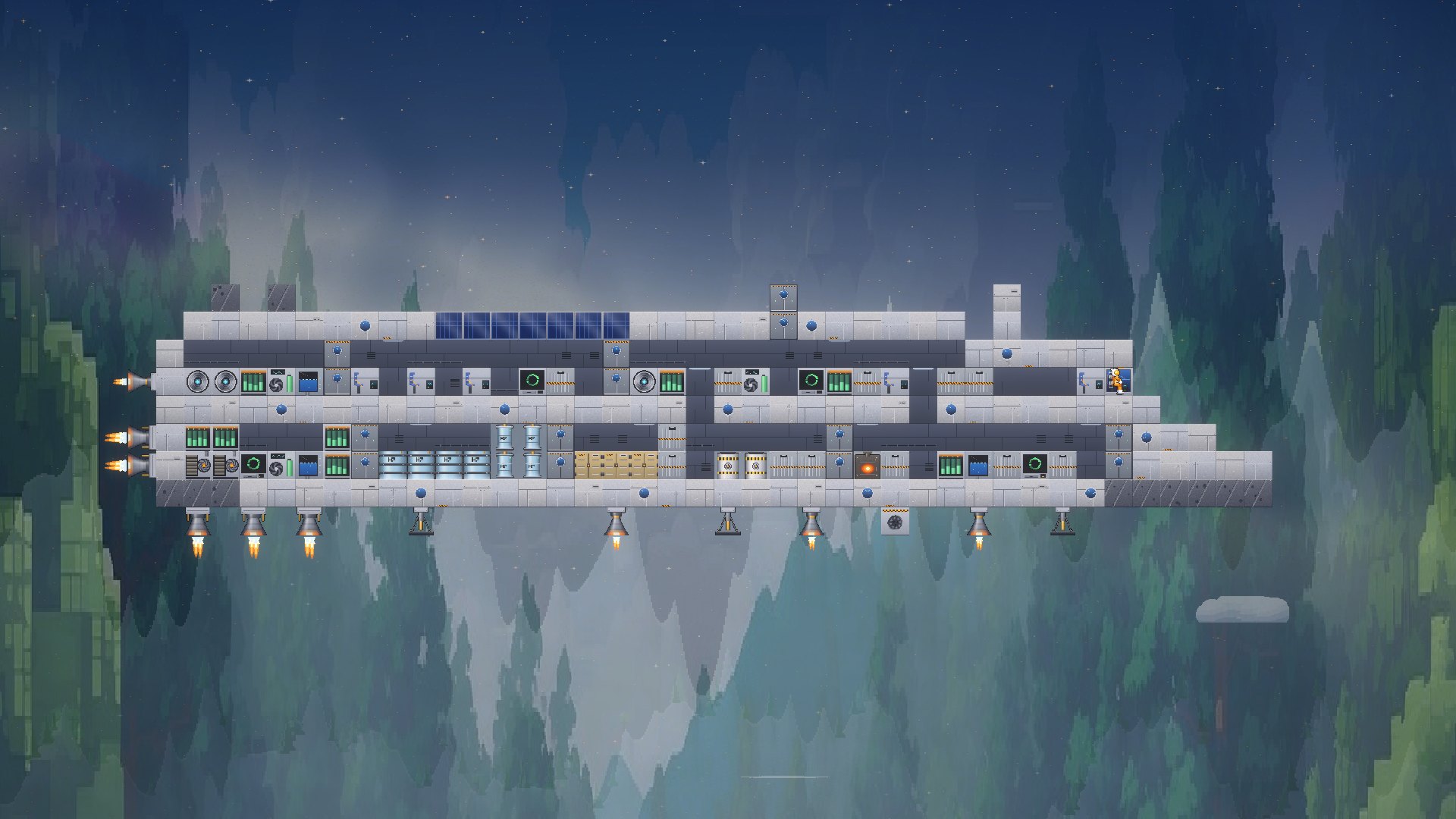
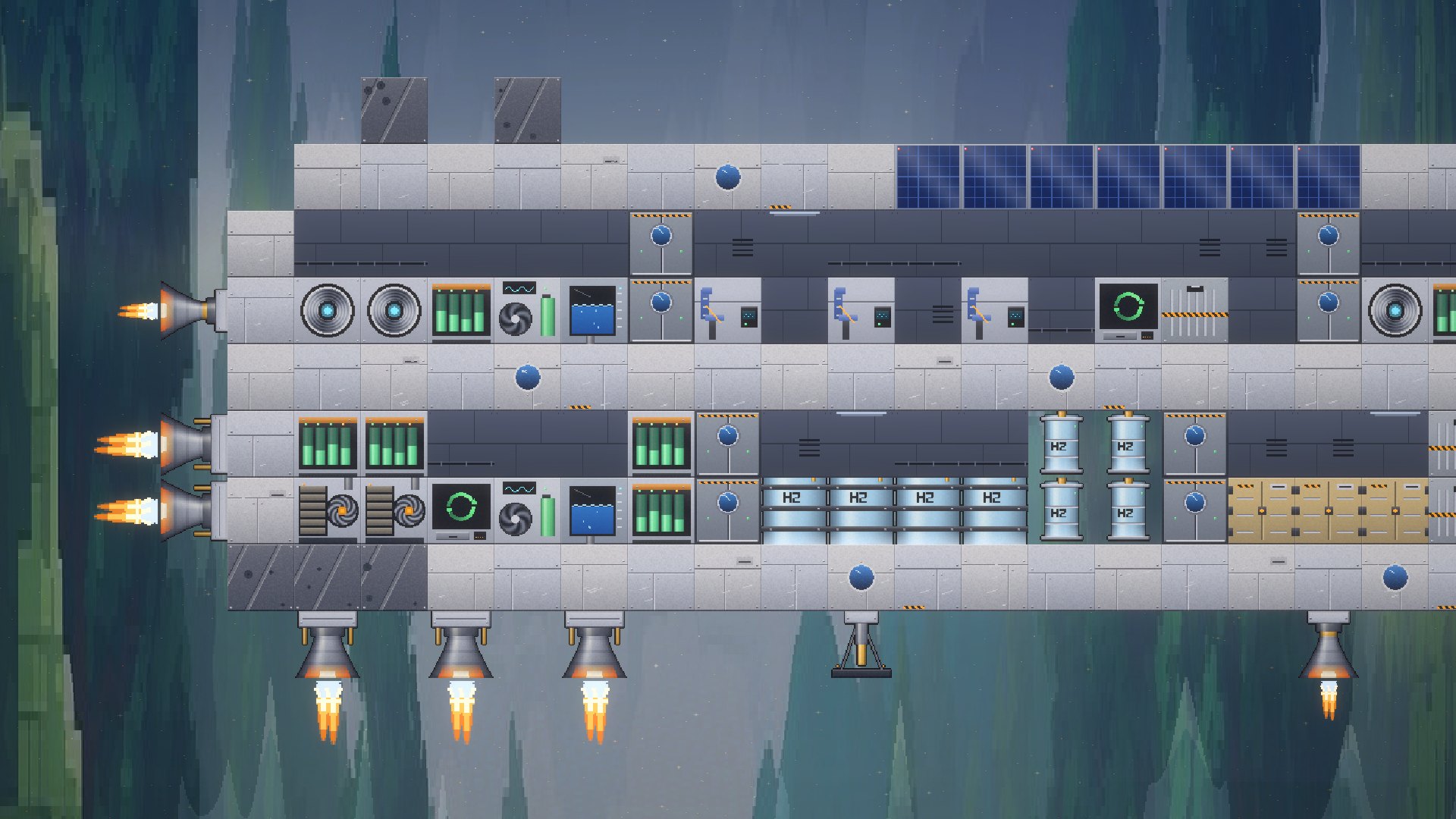
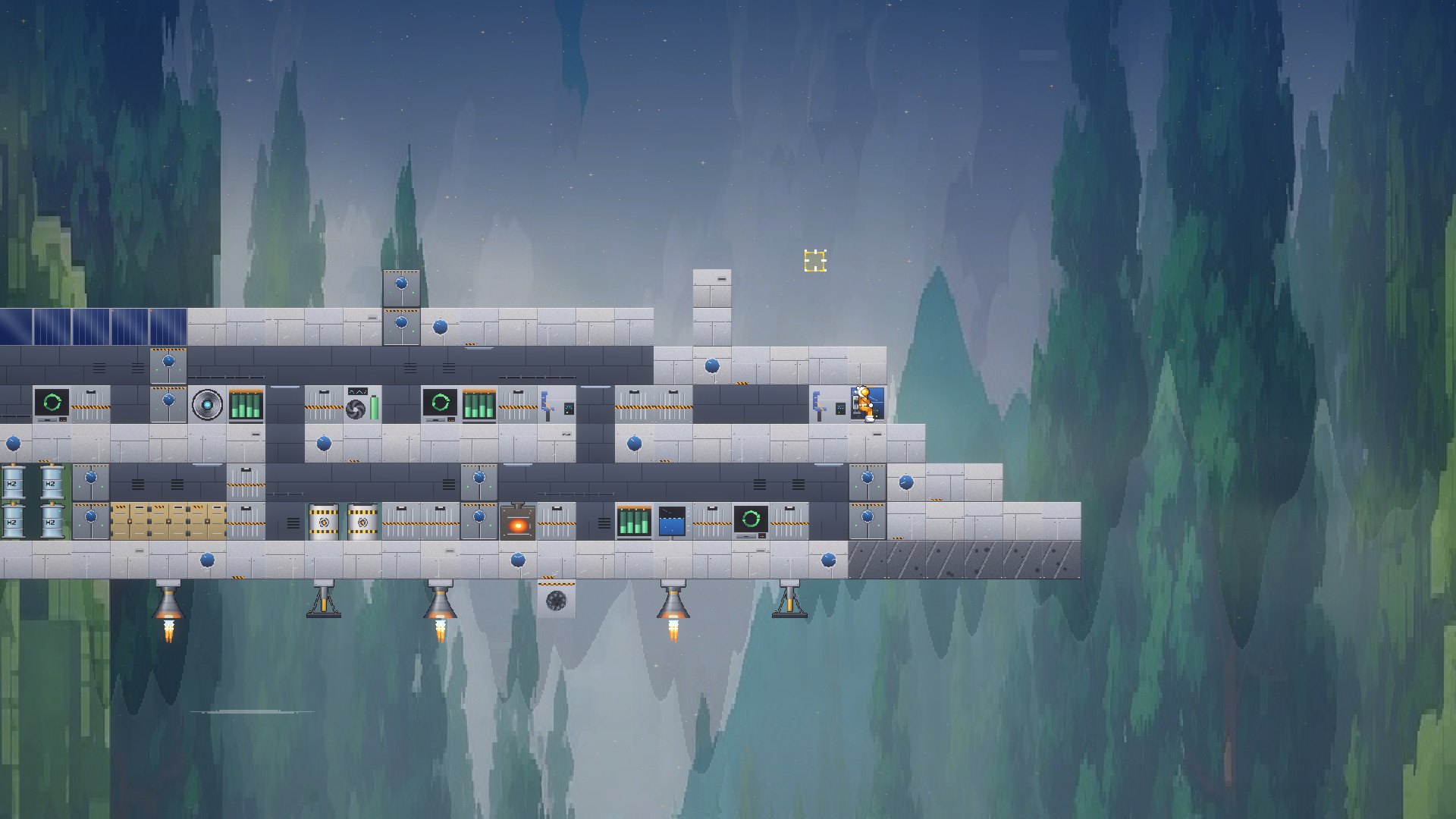
A 40-block cruiser in flight: two decks, bulkheads with airlocks, engine gondolas firing.Engine room and fuel bay: generators, battery racks, cryogenic H₂ tanks, gyroscopes on the upper deck.The bow: glazed cockpit with the pilot seated at the console, armored keel, technical section.
How to build a ship, step by step
Unlock Ships in the research tree, then press K (or Inventory → „Block ship") to open the ship builder.
Start with the Cockpit: it is the core of the ship (one per ship). Every other block must touch an existing block.
Lay the keel and hull.LMB places the selected block, RMB removes one (refunds 50 % of materials). Blocks cost materials from your backpack.
Mount Thrusters under the hull (nozzle down = main lift). R rotates the nozzle while placing: side nozzles give lateral thrust, up gives retro. Every thruster needs a straight exhaust path.
Add H₂ tanks, a Gyroscope (rotation), Landing gear (soft touchdown) and a Battery + Solar panel for onboard power.
Seal the interior: full shell of hull blocks + a Door (airlock). The game detects the hermetic interior automatically: install a Life support module with power and water and the inside fills with breathable air.
Fuel up: place a Refuelling coupling touching the hull; park the ship so the coupling touches a pipe, tank or electrolyzer with hydrogen: it pumps 0.5 kg/s into your tanks.
Board with E at the cockpit: the pilot sits down visibly at the console. Passengers board passenger seats the same way (co-op).
Flight controls
Key
Action
W / Space
main thrust (all down-facing nozzles)
A / D
lateral thrust (side nozzles), wheels drive on the ground
S
retro thrust (up-facing nozzles)
Q / E
rotate the ship (needs a gyroscope and battery power)
E
board / leave (short press at the cockpit or a seat)
LMB
mining ship: run the drill (block „Mining drill", 1.5 kW)
Climb above 240 m with positive vertical speed and you reach orbit: the system map opens and you can travel to other planets. Fuel is real: check the burn rate of your nozzles in the table below.
Land, sea and air vehicles
Wheels drive on terrain using battery power: no fuel needed. More wheels = more force. Rovers and mining crawlers are ships too.
Atmospheric rotors fly on electricity; thrust depends on air density: cheap planetary flight, useless in vacuum.
Wooden hull + floats make boats: floats triple buoyancy; a paddle wheel or rotor propels them.
The interior is real simulation space: temperature, air and pressure are tracked. A closed hull with life support protects you from vacuum, toxic atmospheres and solar storms: your ship is a flying base with an onboard furnace, cargo holds and a water recycler.
All 27 ship blocks
Block
Mass
Stats
Cost
What it does
Hull
120 kg
Steel plate 3 kg
Structural plate: connects blocks, provides collision, floats on water (buoyancy of 16×16 cells). 120 kg.
Cockpit
200 kg
200 Wh
Steel plate 4 kg Integrated circuit 1 kg Glass 2 kg
The ship's core: one per ship, start here. Seat, controls, camera. 200 kg.
Thruster
150 kg
thrust 9 kN
Steel plate 3 kg Electric motor 1 kg
Hydrogen rocket engine: 9 kN of thrust, 30 g H₂/s. Nozzle down = thrust up (W); sideways = manoeuvre (A/D); up = retro (S). [R] rotates while placing. 150 kg.
H₂ tank
90 kg
40 kg H₂
Steel plate 3 kg Steel 2 kg
40 kg of hydrogen per block. 90 kg empty.
Gyroscope
130 kg
Steel plate 2 kg Electric motor 1 kg Integrated circuit 1 kg
Reaction wheels: let you rotate the ship (Q/E) and stabilise flight. More gyros = faster rotation. 130 kg.
1500 kg of storage per block: [E] next to the ship opens the transfer panel. 110 kg empty.
Refuelling coupling
90 kg
Steel plate 2 kg Steel 1 kg Copper 1 kg
Fuel port: when the ship is parked and a pipe, tank or electrolyser with hydrogen sits below/next to the coupling, H₂ flows into the ship's tanks (0.5 kg/s). This is how you refuel from your own production.
Battery
180 kg
5000 Wh
Steel plate 2 kg Copper 3 kg Integrated circuit 1 kg
5 kWh of energy for gyros and the drill. Charged from solar panels. The cockpit has its own 200 Wh.
Solar panel
60 kg
600 W solar
Glass 3 kg Integrated circuit 1 kg Copper 1 kg
600 W in full sunlight (less at night/underground). Charges the ship's batteries.
Large thruster
400 kg
thrust 27 kN
Steel plate 8 kg Electric motor 3 kg Steel 4 kg
Large hydrogen engine: 27 kN of thrust, 90 g H₂/s. Heavy (400 kg), for big ships. [R] rotates the nozzle.
Mining drill
220 kg
Steel 4 kg Electric motor 2 kg Steel plate 2 kg
Mining ship: in flight LMB drills a 1.6×1.6 m area in front of the bit ([R] rotates it), the yield goes into the hold. Draws 1.5 kW from the battery.
Passenger seat
60 kg
Steel plate 1 kg Steel rod 1 kg
A place for a crew member (co-op: the second player boards with E at the seat and rides along). A crewed ship = seats + life-support module.
Life-support module
160 kg
Steel plate 3 kg Integrated circuit 2 kg Steel 2 kg
O₂ generator + CO₂ scrubber: the inside of a sealed hull (enclosed by blocks, doors shut) holds breathable air. Draws 300 W and 1 g of water/s from the hold.
Airlock (door)
50 kg
Steel plate 2 kg Electric motor 1 kg
Hull door: E next to it opens/closes. Shut = a wall (airtight), open = the interior loses its air.
Heavy armour
320 kg
Steel 4 kg Steel plate 2 kg
A thick steel plate: survives hard landings and impacts (block damage, v2.1). 320 kg.
Large hold
300 kg
cargo 4500 kg
Steel plate 8 kg Structural frame 3 kg Steel 2 kg
4500 kg of storage per block: for freighters. Unloaded through a coupling next to a crate.
Large H₂ tank
260 kg
160 kg H₂
Steel plate 6 kg Steel 6 kg
160 kg of hydrogen: interplanetary range for large ships.
Onboard generator
150 kg
2000 W
Steel plate 2 kg Electric motor 1 kg Copper 2 kg
Burns hydrogen from the tanks (0.05 g/s) → 2 kW into the battery. Power at night / underground for the drill, gyros and life support. 150 kg.
Water tank
120 kg
cargo 200 kg
Steel plate 3 kg Steel 2 kg
200 kg of water for life support and crew (the coupling loads water from a tank/pipe next to the ship; panel: "Water into the suit"). Without it, life support draws from the hold (50 kg).
Water and CO₂ recycler
160 kg
Steel plate 3 kg Integrated circuit 2 kg Copper 2 kg
Recovers water vapour and CO₂ from the cabin: life support uses 10× less water (+150 W). Long flights and base-ships without refilling water.
Fluid hold
220 kg
cargo 500 kg
Steel plate 5 kg Steel 4 kg
500 kg of liquid/gas (oil, water, oxygen, kerosene, acid…). Coupling next to a tank: LOAD mode takes from the tank, UNLOAD gives back (ship panel). Fluid transport between bases and planets.
Wooden hull
45 kg
Wood 6 kg
Planks on ribs: a light, cheap all-wood hull for boats and first vehicles. Floats better than steel (45 kg instead of 120 kg), but does NOT hold vacuum and burns in fire.
Drive wheel
70 kg
Steel plate 2 kg Electric motor 1 kg Steel rod 1 kg
WHEELED drive: drives over terrain on battery power (no rocket fuel). A/D to move, climbs slopes, brakes by itself. More wheels means more force, mining vehicles and rovers. On water it acts as a paddle wheel (slower).
Atmospheric rotor
120 kg
Steel plate 3 kg Electric motor 2 kg Integrated circuit 1 kg
ATMOSPHERIC drive: an electric propeller whose thrust depends on air density, cheap flight around a planet WITHOUT burning hydrogen. Useless in vacuum (rocket engines needed there). W/S up-down, A/D sideways.
Float (keel)
60 kg
Wood 4 kg Steel plate 1 kg
Buoyancy chamber: 3× more lift than a normal block and less rolling in waves. A wooden hull plus floats makes a boat; drive it with a paddle wheel or a rotor.
Ship furnace
300 kg
Steel 4 kg Steel plate 4 kg Integrated circuit 1 kg
The ship's electric furnace: smelts ores FROM THE CARGO HOLD (up to 1900 K, iron, copper, glass, silicon, steel); the product goes back to the hold. Ore reduction consumes coal/coke from the hold. 6 kW of ship power, 0.25 kg/s. The heart of a mobile base.
 Conveyor belt
 Pipe
 Pump
 Tank
 Cable
 Battery
 Solar panel
 Crusher
 Assembler
 Wood
 Coal
 Iron
 Copper
 Steel
 Steel plate
 Water
 Ventilation grille
 Exhaust vent
 Air scrubber
 Integrated circuit 1 kg
 Outlet
 Electrolyser
 Silicon 3 kg,
 Glass 3 kg,
 Lithium 2 kg,
 Lamp
 Door
 Heater
 Smelting furnace
 Brick 24 kg,
 Valve
 Insulated pipe
 Radiator pipe
 Assembly
 Combustion generator
 Combustion engine 1 kg,
 Gas centrifuge
 Aluminium 4 kg,
 Electric motor 1 kg
 Nuclear reactor
 Concrete 40 kg,
 Lead 20 kg,
 Structural frame 2 kg
 Steam turbine
 Gear 4 kg,
 Sample works
 Basic furnace
 Clay 20 kg,
 Granite 10 kg
 Ladder
 Wooden crate
 Crate
 Industrial Crate
 Chute
 Signal wire
 Signal wire (green)
 Lever
 Steel rod 1 kg
 Button
 Sensor
 Logic gate
 Timer
 Combinator
 Display
 Greenhouse
 Electric furnace
 Arc furnace
 Coke oven
 Induction furnace
 Blast furnace
 Inserter (arm)
 Vertical lift
 Silo
 Steel converter
 Rolling mill
 Lathe
 Laboratory
 Chemical plant
 Gas generator
 Belt sorter
 Belt splitter
 Liquefier
 Crossover (bridge)
 Screen
 Oxygen generator
 Desalinator
 Oil refinery
 Large tank
 Underground pipe
 Gas pump
 Water purifier
 Leaching plant
 Inclined belt
 Pod (core)
 Molten aluminium
 Ammonia (NH₃)
 Argon (Ar)
 Ash
 Molten slag
 Basalt
 Lava
 Bauxite (aluminium ore)
 Bedrock
 Berries
 Bitumen (asphalt)
 Brass
 Molten copper
 Bronze
 Bush
 Cactus
 Carbon dioxide (CO₂)
 Carbon monoxide (CO)
 Cassiterite (tin ore)
 Chemical filter (activated carbon)
 Chemical sample
 Slag
 Chlorine (Cl₂)
 Coke
 Contaminated water ☢
 Steam
 Copper concentrate
 Copper ore (malachite)
 Copper wire
 Crude oil
 Crystal
 Molten glass
 Depleted uranium ☢
 Molten uranium
 Dirty water
 Dry ice
 Electronic sample
 Enriched uranium (UO₂) ☢
 Fertiliser (ammonium sulphate)
 Flowers
 Fuel rod ☢
 Galena (lead ore)
 Molten iron
 Gold
 Molten gold
 Gold dust
 Gold-bearing gravel
 Grass
 Gravel
 Heavy ice (deuterium)
 Helium (He)
 Helium-3 regolith
 Hide
 Hull (titanium alloy)
 Hydrogen (H₂)
 Ice
 Ilmenite (titanium ore)
 Iron concentrate
 Iron ore (hematite)
 Kerosene
 Molten lead
 Leaves
 Liquid hydrogen
 Liquid methane
 Methane (CH₄)
 Liquid nitrogen
 Nitrogen (N₂)
 Liquid oxygen
 Oxygen (O₂)
 Meat
 Mechanical sample
 Medkit
 Molten nickel
 Molten silicon
 Molten sulphur
 Sulphur dioxide (SO₂)
 Molten tin
 Molten titanium
 Molten zinc
 Monazite (thorium ore) ☢
 Moss
 Mushrooms
 Nickel
 Nuclear sample
 Obsidian
 Particulate filter (HEPA)
 Pentlandite (nickel ore)
 Plastic
 Pod window
 Pyrite (sulphur ore)
 Quantum sample
 Quartz
 Radiological filter (lead + zeolite)
 Radon (Rn) ☢
 Rare earth metals
 Ration pack
 Regolith
 Rock salt
 Salt water
 Sand
 Sandstone
 Snow
 Soil
 Spent fuel ☢
 Sphalerite (zinc ore)
 Spodumene (lithium ore)
 Sulphur
 Sulphuric acid
 Thorium ☢
 Tin
 Titanium
 Turf
 Uraninite (uranium ore) ☢
 Uranium ☢
 Uranium concentrate (yellowcake) ☢
 Vanadium
 Vanadium ore (V-magnetite)
 Vine
 Zinc
 Hull
 Cockpit
 Thruster
 H₂ tank
 Gyroscope
 Landing leg
 Cargo hold
 Refuelling coupling
 Battery
 Solar panel
 Large thruster
 Mining drill
 Passenger seat
 Life-support module
 Airlock (door)
 Heavy armour
 Large hold
 Large H₂ tank
 Onboard generator
 Water tank
 Water and CO₂ recycler
 Fluid hold
 Wooden hull
 Drive wheel
 Atmospheric rotor
 Float (keel)
 Ship furnace